Artisan Glove
Artisan Glove is a sensing-glove design for recording hand contact, vibration and video.
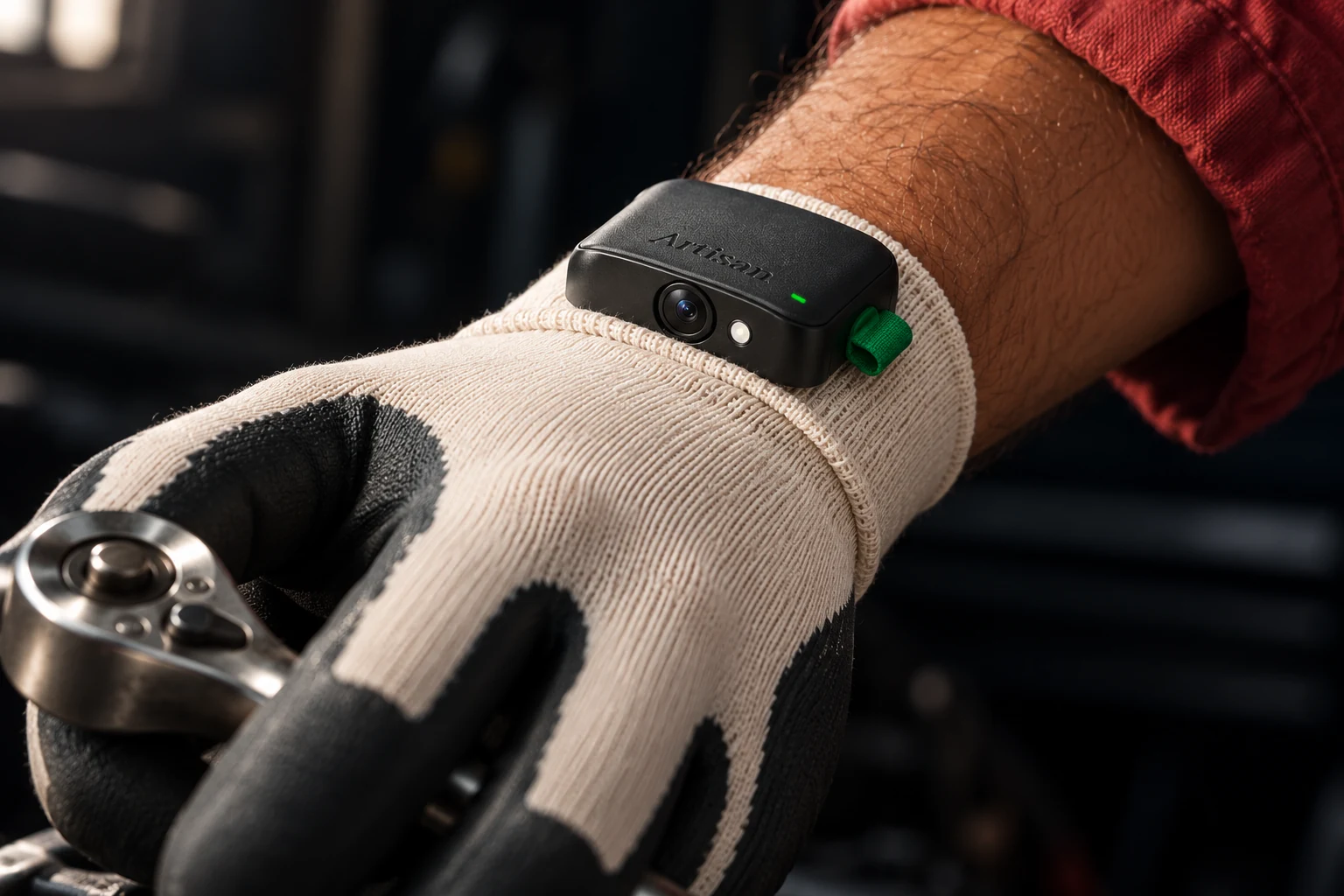
Product concept. The dimensioned V4 engineering enclosure is a separate design you can inspect in the local viewer.
Twenty sensing locations combine pressure-sensitive film and PVDF vibration sensors. Two IMUs distinguish wrist/camera motion from the hand; an ESP32-S3 records timestamped streams and camera frames to microSD, with USB, Wi-Fi and a browser monitor for inspection. It is a reusable engineering project for people building tactile capture hardware, signal-processing experiments and wearable acquisition systems.
Start with the product tour, open the design viewer, or explore the native PCB and enclosure parts.
What you can explore
| Area | What you can do |
|---|---|
| Cuff design | Rotate, open and explode the housing; inspect its camera, battery, connectors, component envelopes and individual parts. |
| Sensing glove | Follow the twenty pressure/PVDF locations, material stack, cut patterns and keyed harness. |
| Electronics | Edit the native KiCad main board and schematics, dorsal IMU tile, footprints, component lists and net mappings. |
| Firmware | Inspect acquisition timing, bus ownership, power transitions, camera deadlines, storage, packet formats and the device browser UI. |
| Verification | Execute the production C++ core and HTTP logic on your computer, decode their actual output, and audit STL clearances. |
| Earlier experiments | Read the Bela sensing pilot and the earlier camera-free V3 board, with their achieved results and open questions kept explicit. |
Current stage
This is a source beta and engineering design in progress. The ESP32-S3 target image was compiled; fresh host checks execute 34 core cases, 13 HTTP cases, 32 protocol/piezo cases and 9 camera-driver cases. The current 561-component V4 board has 20 unconnected items and zero saved physical DRC errors. Its dorsal IMU tile includes fabrication outputs; the main board awaits routing and manufacturing qualification.
An assembled V4 glove, simultaneous acquisition/camera/radio timing, force calibration, enclosure acceptance and six-hour endurance remain physical validation steps. Rates below describe implementation settings and design targets. Status and evidence distinguish each stage.
| Stream | Implementation setting |
|---|---|
| Pressure | 20 locations × 50 samples/s; electrical levels until per-cell force calibration |
| PVDF vibration | 20 locations × 4,000 samples/s |
| Motion | Two ISM330DHCX IMUs at 833 Hz |
| Camera | OV5640 VGA JPEG, approximately 10 fps target |
| Recording | Timestamped, checksummed tactile/motion streams and JPEG frames on microSD |
| Connections | USB and Wi-Fi full streams; BLE setup, status and selected data |
Get started
Python 3.11 or later is enough to open the static design viewer:
git clone https://github.com/latintzar/tactile-glove.git
cd tactile-glove
python3 tools/serve.py
Open http://127.0.0.1:8070/. The viewer loads the supplied engineering geometry locally. Setup covers host tests, native KiCad editing, enclosure checks and the pinned ESP-IDF firmware build. Device assembly and programming have their own acceptance guide.
Source and guides
- Product tour and complete journey
- Module map · Architecture
- Setup · Verification
- Current status · Design history and decisions
- V4 hardware guide · Firmware and protocol
- Earlier Bela experiment
- Contributing and refreshing the inventory
- Source inventory and redistribution scope · Third-party notices
Licence and credits
Peter Neyra’s original code, documentation and hardware design are MIT licensed. Redistributed KiCad library files retain CC BY-SA 4.0 with KiCad’s design-output exception; Espressif camera sources retain Apache 2.0; Seeed and viewer assets retain their own MIT notices. Third-party notices identify those boundaries and source revisions.
Made by Atelier Neyra.