Messier ’57
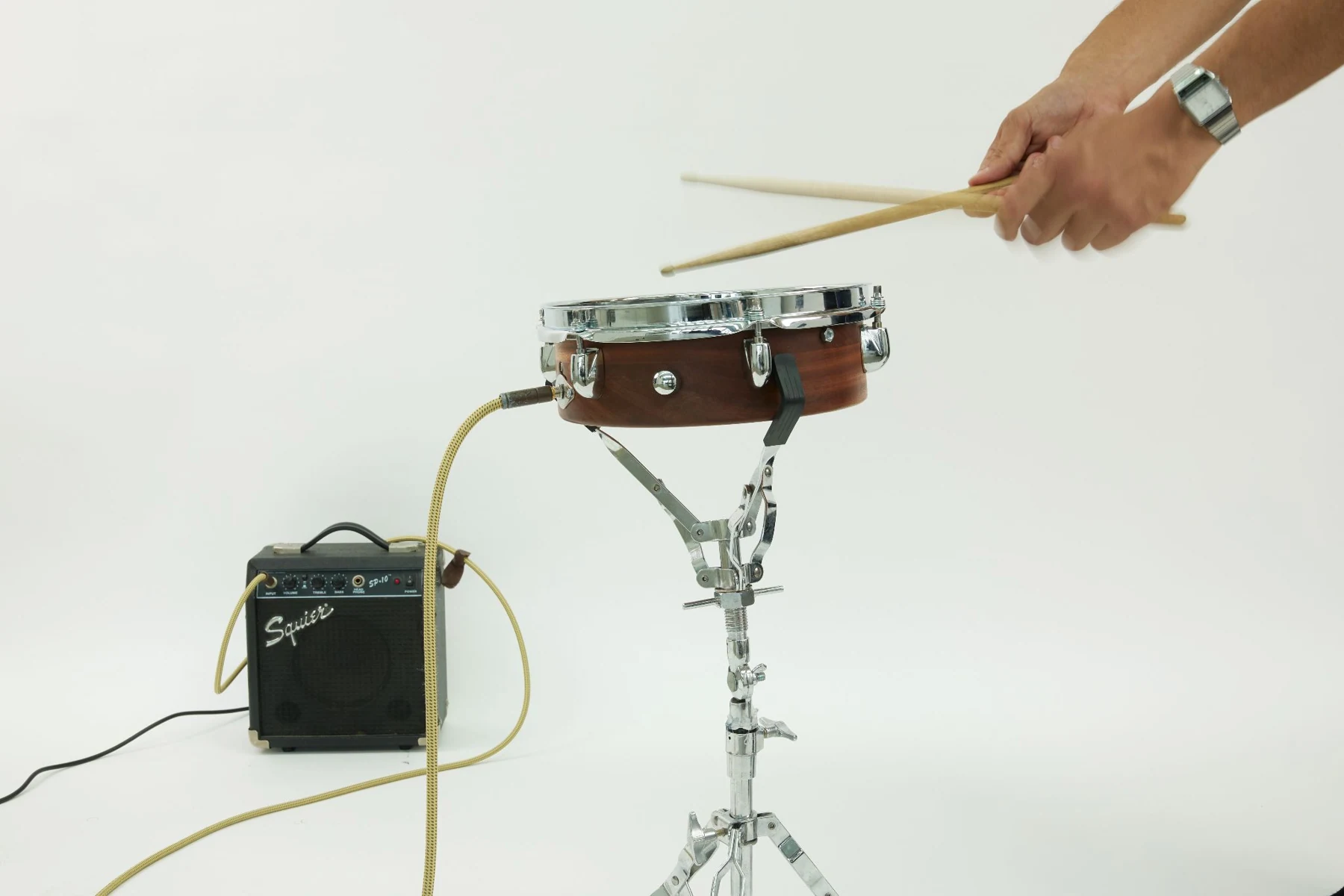
Messier ’57 is an electric drum with an acoustic feel, played through an amp or guitar pedal.
I designed and built it to give drummers a wider sonic palette while preserving the touch of head and rim playing. The published project includes a playable browser instrument, a Pure Data edition, the original Rhino CAD, parts and build records.
Who it helps
Drummers exploring electronic sounds, and instrument builders who want a working physical-modelled snare and the design files behind it.
The problem
Electronic sound needs to follow the player’s touch: brushes, quiet strokes, rim hits and changes in tension. A familiar drum surface and a physical snare control keep those gestures in the hands of the musician.
What it needs
- Head and rim response that carries the player’s excitation into the sound model.
- A control for loosening the snares while playing.
- A direct path to amplification and a portable way to try the sound engine.
What it does
Physical-modelled snare
The browser runs the actual snare patch through pinned libpd C/WASM. The native edition runs in Pure Data. Original model and helper provenance is retained with the source.
Head, rim and latch
Play the head or rim, choose Head / Rim / Both, and hold S or the brass latch to loosen the snare. The browser provides explicit audio choice, one volume and Stop.
Editable grooves
Ten grooves include kick. The visible kick, head and rim sequencer lets a visitor edit the rhythm. The audition adds a later low-tuned CHAIR bongo kick and shared stereo room reverb.
Design files and build record
The source includes original Rhino CAD, the BOM, specifications, build notes and separately identified Blender and GLB visualisation files. Historical Bonk, Bela and training patches retain their original context.
How it works
- In the physical prototype, a lavalier and an edge contact microphone capture playing excitation.
- The audio excites one physically modelled snare in Pure Data.
- A brass latch changes the snare response; a short spring returns its shaft when released.
- The output connects to an amplifier or guitar effects.
- The browser audition uses included excitation recordings, manual zone controls and the same snare model, followed by shared room reverb.
Design decisions
- Keep a familiar shell, hoop, head and stand so the playing gestures remain recognisable.
- Use the playing signal as excitation for synthesis.
- Give snare loosening a physical control that can be held during a stroke.
- Keep the original Rhino design, presentation models and prototype evidence identified separately.
- Ship the player, fonts, models, recordings and DSP runtime locally for a short path to the first sound.
Current state
The reviewed source beta contains runnable browser and Pure Data auditions. The browser uses manual head/rim selection; the original Bonk and hardware patches are preserved as historical source. The physical instrument was developed at the RCA, exhibited at the London Design Festival, and tested through its prototype stages with Ayo Salawu and Dru Masters.
Continue the project
Use the current source to explore the sound and interface. The build notes identify measurements to recover for microphone conditioning, power and charging, latch endpoints, spring behaviour and finished-drum fit. Hardware work can continue from those records and the retained original patches.
Build with it
Repository guide · Architecture · Function index · Build notes · Specifications · Agent skill · Bill of materials